
Respiratory Monitoring & Control
Modeling, monitoring and control of respiratory support
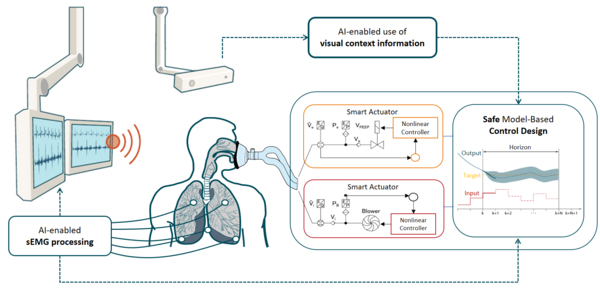
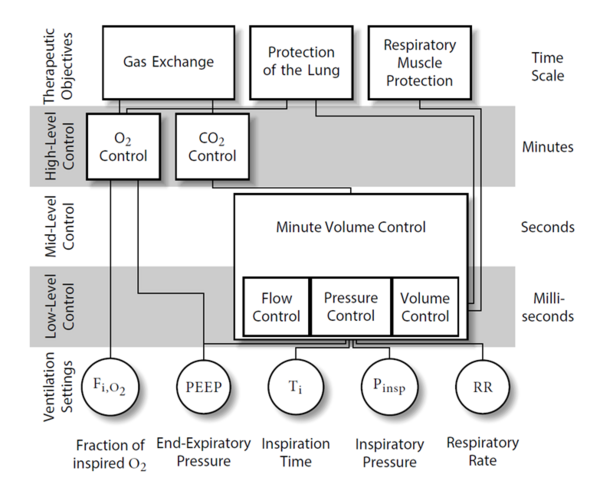
Digital patient models built on transparent, physics- and physiology-based white-box mathematics bring clarity to mechanical ventilation. By explicitly modeling gas exchange (alveolar ventilation, diffusion, V/Q matching, shunt, blood–gas dynamics), lung mechanics (compliance, resistance, ressure–volume loops), and the respiratory control center (chemoreflex and neural drive, responses to CO2/O2 and sedation), they provide explainable simulations of patient-ventilator interactions.
2020
Spatio-Temporal Gaussian Processes for Separation of Ventilation and Perfusion Related Signals in EIT Data, in Proc. Workshop Automed , 2020.
| Bibtex: |  @inproceedings{GrRo20,
author = {Jan Graßhoff and Philipp Rostalski},
title = {Spatio-Temporal Gaussian Processes for Separation of Ventilation and Perfusion Related Signals in EIT Data},
year = {2020},
booktitle = {Proc. Workshop Automed}
}
|
Removing Cardiac Artifacts From Single-Channel Respiratory Electromyograms, {IEEE} Access , vol. 8, pp. 30905--30917, 2020. Institute of Electrical and Electronics Engineers ({IEEE}).
| DOI: | 10.1109/access.2020.2972731 |
| File: | 8988257 |
| Bibtex: | @Article{PeSaGrRo20,
author = {Petersen, Eike and Sauer, Julia and Graßhoff, Jan and Rostalski, Philipp},
title = {Removing Cardiac Artifacts From Single-Channel Respiratory Electromyograms},
journal = {{IEEE} Access},
year = {2020},
volume = {8},
pages = {30905--30917},
doi = {10.1109/access.2020.2972731},
groups = {ECG Removal from EMG recordings},
publisher = {Institute of Electrical and Electronics Engineers ({IEEE})}
}
|
On the Estimation of Optoacoustic Waves in Retinal Laser Therapy Using Gaussian Processes, in Proc. Workshop Automed , Lübeck, Germany , Mar.2020.
| Bibtex: | @INPROCEEDINGS{AbGrRoBr20,
author={Abbas, Hossam S. and Graßhoff, Jan and Rostalski, P. and Brinkmann, R.},
booktitle={Proc. Workshop Automed},
title={{On the Estimation of Optoacoustic Waves in Retinal Laser Therapy Using Gaussian Processes}},
year={2020},
pages={},
address={Lübeck, Germany},
month={March}
}
|
Surface EMG-based Estimation of Breathing Effort for Neurally Adjusted Ventilation Control, in {Proceedings of the 21st IFAC World Congress} , 2020.
| Bibtex: | @inproceedings{PeGrEgRo20,
author = {Petersen, Eike and Graßhoff, Jan and Eger, Marcus and Rostalski, Philipp},
booktitle = {{Proceedings of the 21st IFAC World Congress}},
title = {Surface {EMG}-based Estimation of Breathing Effort for Neurally Adjusted Ventilation Control},
year = {2020}
} |
Scalable Gaussian Process Separation for Kernels with a Non-Stationary Phase, in Proceedings of the 37th International Conference on International Conference on Machine Learning (ICML) , 2020.
| Bibtex: | @inproceedings{GrJaRo20,
author = {Graßhoff, Jan and Jankowski, Alexandra and Rostalski, Philipp},
title = {Scalable Gaussian Process Separation for Kernels with a Non-Stationary Phase},
booktitle = {Proceedings of the 37th International Conference on International Conference on Machine Learning (ICML)},
year = {2020}
} |
Registration of Image Modalities for Analyses of Tissue Samples using 3D Image Modelling, PROTEOMICS -- Clinical Applications , 2020. Wiley.
| DOI: | {{10.1002/prca.201900143}} |
| File: | prca.201900143}} |
| Bibtex: | @article{HeBr20,
title={Registration of Image Modalities for Analyses of Tissue Samples using 3D Image Modelling},
author={Hermann, Juliane and Brehmer, Kai and Mahfoud, Felix and Speer, Timotheus and Schunk, Stefan J. and Tscherning, Thomas and Thiele, Herbert and Jankowski, Joachim},
journal={PROTEOMICS -- Clinical Applications},
year={2020},
publisher={Wiley},
} |
2019
Automatic Estimation of Respiratory Effort using Esophageal Pressure, in 2019 41st Annual International Conference of the IEEE Engineering in Medicine and Biology Society (EMBC) , Jul.2019. pp. 4646-4649.
| DOI: | 10.1109/EMBC.2019.8856345 |
| Bibtex: | @inproceedings{GrPeBeRo19,
author={J. {Graßhoff} and E. {Petersen} and T. {Becher} and P. {Rostalski}},
booktitle={2019 41st Annual International Conference of the IEEE Engineering in Medicine and Biology Society (EMBC)},
title={Automatic Estimation of Respiratory Effort using Esophageal Pressure},
year={2019},
pages={4646-4649},
doi={10.1109/EMBC.2019.8856345},
ISSN={1557-170X},
month={July}}
|
Deep Learning for Prediction of Diaphragm Activity from the Surface Electromyogram, in Directions in Biomedical Engineering , De Gruyter, 2019. pp. 17--20.
| Bibtex: | @inproceedings{BoGrHaHeRo19,
author = {Niclas Bockelmann and Jan Graßhoff and Lasse Hansen and Mattias Heinrich and Philipp Rostalski},
title = {Deep Learning for Prediction of Diaphragm Activity from the Surface Electromyogram},
booktitle = {Directions in Biomedical Engineering},
year = {2019},
publisher = {De Gruyter},
pages = {17--20},
volume = {5},
number = {1}
}
|
2018
Sparse Estimation for the Assessment of Muscular Activity based on sEMG Measurements, in Proc. 18th Symp. Syst. Ident. , 2018.
| Bibtex: | @inproceedings{OlPeHoRo18,
author = {Olbrich, Michael and Petersen, Eike and Hoffmann, Christian and Rostalski, Philipp},
abstract = {},
title = {{Sparse Estimation for the Assessment of Muscular Activity based on sEMG Measurements}},
year = {2018},
booktitle = {Proc. 18th Symp. Syst. Ident.}
}
|
2017
A Template Subtraction Method for the Removal of Cardiogenic Oscillations on Esophageal Pressure Signals, in Proc. 39th Ann. Int. Conf. Eng. Med. Biol. Soc. , 2017.
| Bibtex: | @inproceedings{GrPeEgBe17,
author = {Graßhoff, Jan and Petersen, Eike and Eger, Marcus and Bellani, Giacomo and Rostalski, Philipp},
abstract = {Esophageal pressure (Pes) is usually measured in patients receiving mechanical ventilation and is used for the assessment of lung mechanics. However, its interpretation is complicated by the presence of cardiogenic oscillations (CGO). In this article we present a novel method for the reduction of CGO based on the identification of pressure templates. Similar approaches are known for the removal of electrocardiographic (ECG) artifacts from the electromyogram (EMG). The proposed method is tested on clinical recordings of patients under assisted spontaneous ventilation. Besides the improvement of the respiratory signals, the identified CGO templates can be used diagnostically when viewed in relation to corresponding ECG data. This approach is illustrated on a few sample datasets.},
title = {{A Template Subtraction Method for the Removal of Cardiogenic Oscillations on Esophageal Pressure Signals}},
year = {2017},
booktitle = {Proc. 39th Ann. Int. Conf. Eng. Med. Biol. Soc.}
}
|
Convolutive blind source separation of surface EMG measurements of the respiratory muscles, Biomed. Tech. , vol. 62, no. 2, pp. 171--181, 2017.
| Bibtex: | @article{PeBuEgRo17,
author = {Petersen, Eike and Buchner, Herbert and Eger, Marcus and Rostalski, Philipp},
abstract = {Electromyography (EMG) has long been used for the assessment of muscle function and activity and has recently been applied to the control of medical ventilation. For this application, the EMG signal is usually recorded invasively by means of electrodes on a nasogastric tube which is placed inside the esophagus in order to minimize noise and crosstalk from other muscles. Replacing these invasive measurements with an EMG signal obtained non-invasively on the body surface is difficult and requires techniques for signal separation in order to reconstruct the contributions of the individual respiratory muscles. In the case of muscles with small cross-sectional areas, or with muscles at large distances from the recording site, solutions to this problem have been proposed previously. The respiratory muscles, however, are large and distributed widely over the upper body volume. In this article, we describe an algorithm for convolutive blind source separation (BSS) that performs well even for large, distributed muscles such as the respiratory muscles, while using only a small number of electrodes. The algorithm is derived as a special case of the TRINICON general framework for BSS. To provide evidence that it shows potential for separating inspiratory, expiratory, and cardiac activities in practical applications, a joint numerical simulation of EMG and ECG activities was performed, and separation success was evaluated in a variety of noise settings. The results are promising.
~
Electromyography (EMG) has long been used for the assessment of muscle function and activity and has recently been applied to the control of medical ventilation. For this application, the EMG signal is usually recorded invasively by means of electrodes on a nasogastric tube which is placed inside the esophagus in order to minimize noise and crosstalk from other muscles. Replacing these invasive measurements with an EMG signal obtained non-invasively on the body surface is difficult and requires techniques for signal separation in order to reconstruct the contributions of the individual respiratory muscles. In the case of muscles with small cross-sectional areas, or with muscles at large distances from the recording site, solutions to this problem have been proposed previously. The respiratory muscles, however, are large and distributed widely over the upper body volume. In this article, we describe an algorithm for convolutive blind source separation (BSS) that performs well even for large, distributed muscles such as the respiratory muscles, while using only a small number of electrodes. The algorithm is derived as a special case of the TRINICON general framework for BSS. To provide evidence that it shows potential for separating inspiratory, expiratory, and cardiac activities in practical applications, a joint numerical simulation of EMG and ECG activities was performed, and separation success was evaluated in a variety of noise settings. The results are promising.
//
Electromyography (EMG) has long been used for the assessment of muscle function and activity and has recently been applied to the control of medical ventilation. For this application, the EMG signal is usually recorded invasively by means of electrodes on a nasogastric tube which is placed inside the esophagus in order to minimize noise and crosstalk from other muscles. Replacing these invasive measurements with an EMG signal obtained non-invasively on the body surface is difficult and requires techniques for signal separation in order to reconstruct the contributions of the individual respiratory muscles. In the case of muscles with small cross-sectional areas, or with muscles at large distances from the recording site, solutions to this problem have been proposed previously. The respiratory muscles, however, are large and distributed widely over the upper body volume. In this article, we describe an algorithm for convolutive blind source separation (BSS) that performs well even for large, distributed muscles such as the respiratory muscles, while using only a small number of electrodes. The algorithm is derived as a special case of the TRINICON general framework for BSS. To provide evidence that it shows potential for separating inspiratory, expiratory, and cardiac activities in practical applications, a joint numerical simulation of EMG and ECG activities was performed, and separation success was evaluated in a variety of noise settings. The results are promising.},
year = {2017},
title = {{Convolutive blind source separation of surface EMG measurements of the respiratory muscles}},
pages = {171--181},
volume = {62},
number = {2},
journal = {Biomed. Tech.},
note = {Evaluation Studies
Journal Article}
}
|
Members
Philipp Rostalski

Gebäude 19
philipp.rostalski(at)uni-luebeck.de
+49 451 3101 6200
Jan Graßhoff

Gebäude 19
j.grasshoff(at)uni-luebeck.de
+49 451 3101 6216
Georg Männel

Gebäude 19
ge.maennel(at)uni-luebeck.de
+49 451 3101 6214
Sandra Henn

Gebäude 19
s.henn(at)uni-luebeck.de
+49 451 3101 6225
Julia Sauer

Gebäude 19
j.sauer(at)uni-luebeck.de
+49 451 3101 6217
Carlotta Hennigs

Gebäude 19
carlotta.hennigs(at)uni-luebeck.de
+49 451 3101 6218
Franziska Bilda (née Schollemann)

Gebäude 19
franziska.bilda(at)uni-luebeck.de
+49 451 3101 6234